Thursday, 14 June 2012

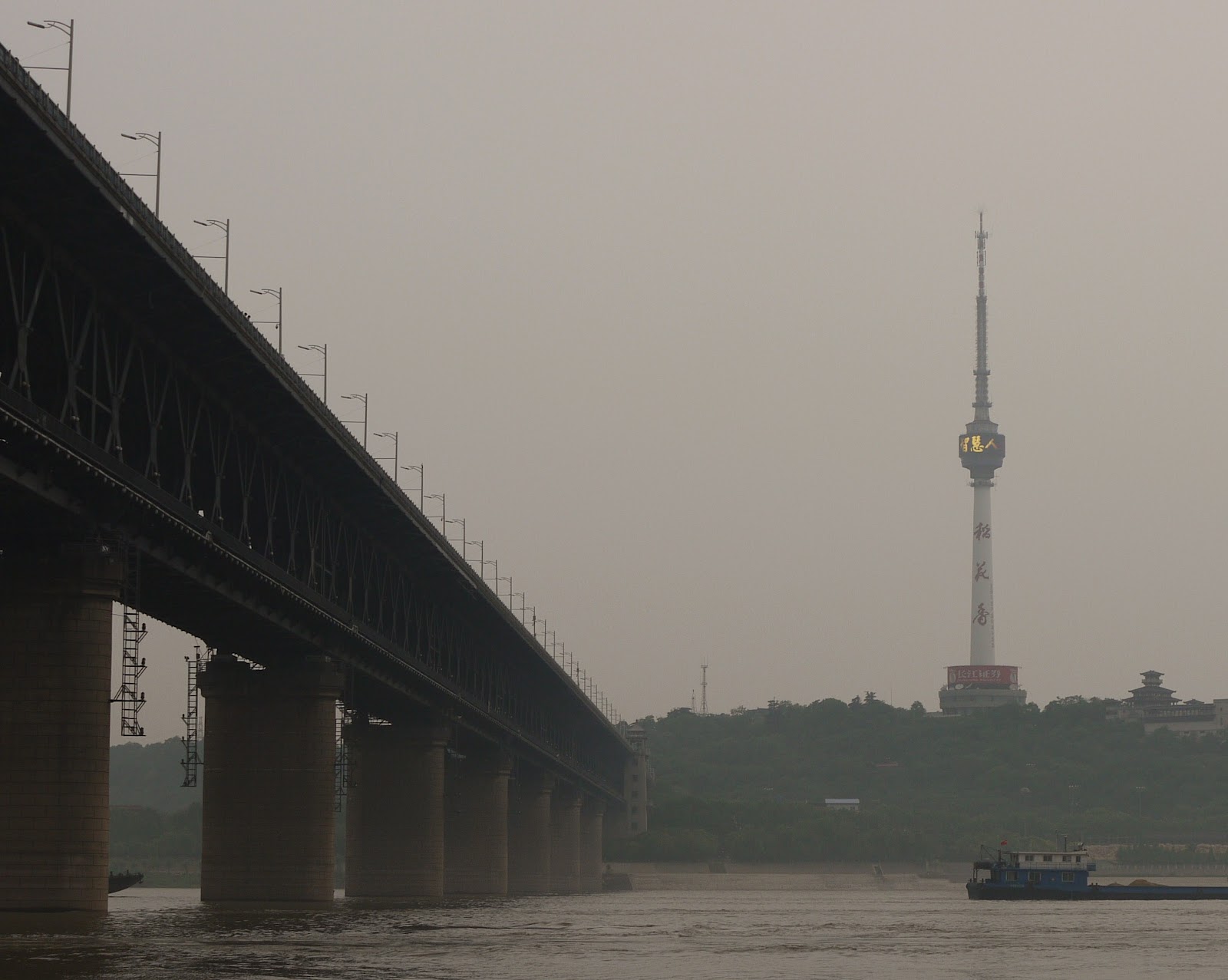
The Wuhan Yangtze River Bridge (武汉长江大桥)


In 1927, the cities of Wuchang, Hankou and Hanyang were merged to form the city of Wuhan. Wuhan today is a vast agglomeration, capital of Hubei province, and in its center a massive steel bridge spans over the river Yangtze to connect the city's different parts:


It was here, just at the foot of the bridge, that chairman Mao performed his famous swim across the river in July 1966. At the time, the swim had vast implications - showing that the chairman was still strong and vigorous, it re-consolidated his contested position in the party, making it possible for him to entrench the cultural revolution he had launched shortly before.

The swim is still remembered today. When I was there, some dudes were just preparing for a commemorative crossing:


The swim is not an easy feat - apart from the indefinable thick-brownish waters, the current is very strong, and the river is full of all kinds of ships. But these guys were tough.


Soon, they were only tiny spots among the mighty ships travelling upstream.


From the bridge, one could see the ships from above.


Many of those going upriver were empty, while the ones going down lay deep in the water, full of sand for the busy building sites on China's eastern coast.


Monday, 11 June 2012

Putin, Russia's Elections and the Internet

During Russia's recent presidential election, Rossija bez Putina (Russia without Putin) was one of the main slogans of the opposition. The slogan was subtly used in a couple of videos both by government sympathisers and the opposition, to conjure up the fears and hopes that Russians associate with political change. The videos are extremly interesting, both as a method of political campaigning, and as insights into different views, fears and projections of Russia's future.

An apocalyptic pro-government version asks (freely summarized and translated by myself):  

Imagine for once - Russia without Putin: presidential elections are canceled, the Duma dissolved, the opposition triumphs, 200 new parties compete for parliament, nationalists and liberals win, Western powers greet the beginning of genuine democracy in Russia. The new rulers divide the Russian economy among themselves,..., as a gesture of good-will, the Russian nuclear arsenal is put under control of the US. After internal divisions, the nationalists leave the government and start an underground insurrection. A new economic crisis hits the world, thousands of firms have to close in Russia. The government decides to close Avtovaz, workers in Tolyatti demand the separation of their region from the country. The central bank feverishly prints money, hyper-inflation, the cost of bread climbs astronomically, leading international companies start leaving... In all large Russian cities, fascist groups fight ethnic mafias...skinheads win elections in St. Petersburg...after a hungry winter, local nationalists win regional elections, a number of regions declare their independence, the republics in the northern Caucasus establish an Islamic emirate, 100.000 refugees flee the Caucasus, civil war...under the pretext of a peace-keeping operation, NATO forces occupy Kaliningrad, China occupies parts of Siberia, the Japanese put peace-keepers into Vladivostok. Georgia invades Southern Russia...the world speaks about a humanitarian disaster in Russia...in December 2013, Alexey Navalny gets the Nobel price for peace and the Noble price for literature...in February 2014, Georgia conducts the Winter Olympics in Sochi. The Russian team is not admitted. In Moscow the transmission of the opening ceremony leads to street battles, electricity, telephone and internet stop working, citizens are advised not to leave their houses. Russia without Putin: choose by yourself!      


Much of the footage used is from the chaotic 1990s, implying that Putin leaving office would plunge the country back into a situation similar to post-Perestroika chaos, leaving it without defense against internal and external agressors.
 
Another, less apocalyptic version asks subtle questions about the hidden interests of the Russian opposition, and the ensuing re-distribution of interests and property once they have come to power:


Yet another (and in my opinion, not that unjustified) question is the one about potential alternatives to Putin in charge. Zyuganov and a return to Communism? Zhirinovsky? Navalny? Probably the major problem of Russia's current opposition is its lack of a team of credible and capable leaders and specialists to take over if Putin would step down.


A further problem is the absence (at least, until now) of a credible and thought-through programme. The following pro-opposition video paints a hopeful picture of Russia without Putin, and contains some elements that could indeed become part of a future opposition programme - the putting into place of a personal accountability system for Russian bureaucrats and politicians (instead of making their promotion dependent on their political support of the center), the re-introduction of a progressive tax system, investments into infrastructure, and a more effective industrial policy. Even though the end of the video is probably slightly utopian (by 2018, Belarus and Ukraine will have joined a resurgent Russia, making it the second-strongest economy in the world), the film makes at least some real suggestions and is not simply based on conjuring-up fear.


However, there is probably still a long way to go until Russia's opposition manages to establish a platform that could somehow rally around a constructive programme. It seems that the one thing Putin has really been effective in establishing is a system that leaves, at least for now, few alternatives to himself.

Friday, 8 June 2012

The West Lake (西湖)


South of Shanghai lies the city of Hangzhou, which is home to the famous West Lake. Surrounded by lush green mountains and countless pagodas, temples and gardens, the peaceful lake is a perfect example of classical China:

 
If you are lucky, you can see large fish gliding through the mysterious waters:


One afternoon, I put on my hiking boots and went for the mountains behind the lake:


From the lake's western shore, a long set of stairs leads through dense vegetation up into the hills.


Higher up, the forest is less dense and you reach some tea plantations. In one of the fields, a friendly farmer was working.


Later on, I came to a village where people were drying tea leaves:


The next morning, I walked to the lake's northern shore. On an island was a park with a couple of buildings, where in former times wise men gathered to write poetry and practice calligraphy:


Emperor Qianlong (1711 - 1799) named one of the paths in the park the path of green clouds, and composed a poem to describe it:

                                        The roads lead to mysterious sights,
                                        the woods pierce into the high clouds.
                                        About the footprints on the moss,
                                        the woodman knows nothing.
                                        Misty cranes' feathers, watery snails' patterns.
                                        As gorgeous as the East Mountain,
                                        only there is too much bamboo.

Wednesday, 6 June 2012

Large Planes to China

There are different ways to get from Europe to China. One can travel by using slow boats, as Gavin Young did in the early 1980s, or walk and hitch-hike like Nick Danziger. You can cross Russia by train, attempt the feared North-West passage (which due to climate change is becoming more navigable), or travel from Moscow through Central Asia in the steps of Peter Fleming. One can also follow Marco Polo and the silk road, as Bradley Mayhew did for a beautiful recent documentary:


However, most people today use large planes. If you fly with Emirates, there is not only good food and a selection of 400 movies, but also a useful indicator showing the precise position of the plane with respect to Mecca:


After crossing Turkey and Iraq and a stopover in Dubai, the route goes over Iran, Pakistan and India towards China:


From the window, one could see many a desert, mountain and river. I got so exited thinking about the traders that in ancient times traveled these roads by camel, donkey or on foot that I completely forgot to watch at least one of the 400 movies.


Once arrived in Shanghai, the Nanjing Hotel is a good place to stay. Suites are arranged reasonably, one can enjoy unusual metropolitan feelings, business opportunities are revenled to the tullest, fragrance swims and joy diffuses. And the beds are large and comfortable, which is very nice after a long flight.


The next morning, I woke up to the sound of The East is Red, the song that was the unofficial anthem of China's cultural revolution.  

                                                  The east is red, the sun rises. 
                                                  China has produced Mao Zedong.
                                                  He is the people's happiness,
                                                  Hurrah, He is the people's great savior!


Since 2003, the song is again played every hour from the Customs House clock-tower on the Bund in Shanghai, which was not far from my hotel room (between 1980 and 2003 and before the cultural revolution, the clock-tower played the Westminster Quarters, as the building had been constructed by the British in 1927).


Sunday, 15 April 2012

The Crimean Tatars

Recently I found an amazing poem on youtube. The poem was written and is read by Lilya Takosh, chief editor of the Crimean newspaper Первая Крымская. It is about the return of the Crimean Tatars to their homeland, from where they had been deported by Stalin in 1944 (an English translation is under the video on youtube).


After being deported to Uzbekistan in 1944, the Crimean Tatars were only allowed back in the mid-1980s, by which time their land had long been occupied by Ukrainians and Russians. This led to tensions upon their return, and the UN had established a special branch office in Simferopol, the capital of Crimea, to somehow help alleviating conflicts between the different ethnic groups. Back in 2006/2007, I did a 4-months internship at this office.

During the internship, I lived with an elderly Russian lady in the settlement of Pnevmatika, above Simferopol, which looked from afar a bit like a gigantic alien spaceship:


Every morning, a large breakfast was waiting in the small kitchen, because allegedly I was much to thin (on the table you can see a portion of kasha, steak with potatos, blinchiki, a tomato and pepper salad, chocolate cake, fruit and a large cup of coffee, while on the wall is a map of the Crimea). These were good times!


During my stay, the situation between Crimean Tatars, Ukrainians and Russians deteriorated. The Crimean Tatars were frustrated that although having been granted a legal right to be compensated for the land they had lost in 1944, the land they received as compensation was often of inferior quality. While they had lived before on the southern shore and around the central mountains, they now were given land situated mainly in the infertile northern steppes of the Crimea.

As a form of protest, they started in early 2006 to massively occupy land, building small symbolic houses, as in this picture of a hill south of Simferopol:


When the authorities tried to dismantle some settlements, it came to clashes. Fearing escalation, the state backed down, and an uneasy stalemate ensued.

At the UN, we were writing reports about the situation, although I think nobody ever read them (during my stay, a consultant from UN-Habitat was working on a more comprehensive study of the issue, which can be found here). There were also a couple of programmes trying to promote mutual understanding between the different ethnic groups. Some worked quite well, as this project to provide financial help to parents' associations in local schools (the idea was that Ukrainian, Russian and Crimean Tatar parents should spend their Saturday afternoons together, renovating their childrens' classrooms):


Eventually, the situation calmed down somewhat. When I came back for a visit in 2008, some of the occupied areas had become genuine small villages, and people were constructing real houses:


However, with the coming to power of a new pro-Russian government in Kyiv in 2010, worries about possible future tensions remain  (this reportage on Al Jazeera provides a recent update).


Wednesday, 11 April 2012

Magnetic Mountain


At about 5am in late September 2010, I stumbled out of my cold room in the hotel Yuzhny Ural in Chelyabinsk, to get on the first bus to Magnitogorsk. The journey takes about five hours, and after two hours on the road it was slowly getting light. We were driving through the southern Russian steppe, past an enormous coal-fired power station, some churches with golden cupolas, and a group of riders guarding a flock of what looked like wild horses. Around 9, the bus stopped at a small service station, and we had a coffee. On an iron fence nearby, somebody had written:


That was where we were going.

Soon afterwards, the sky became somehow darker, although there were no clouds. Then all of a sudden the bus passed between two hills, and there it lay, like a huge living beast:

Magnitka. Magnetic Mountain.


The steel factory was build in the early 1930s, as part of Stalin's industrialization
drive that aimed to provide the Soviet Union with heavy industry beyond the reach
of  the country's potential enemies. Princeton historian Stephen Kotkin has written
a book about the construction of the factory and its sourrounding city, a true
masterpiece.


There is also a Soviet movie about the factory's construction, Время, Вперед! (Time, Forward!), from 1965. The soundtrack by Georgy Sviridov is brilliant, so much so that until 1991 it was used as the opening theme for the main evening news on Soviet television.

A second, less known film about the building of Magnitka is the documentary Song of Heroes (1932) by the Dutch filmmaker Joris Ivens. Unlike in Время, Вперед!, here much of the footage is original, which makes the documentary most interesting to watch.


During the first years, a number of foreign volunteers and specialists participated in the construction of the steelworks. One of them was the American John Scott, whose book Behind the Urals: An American Worker in Russia's City of Steel makes you feel as if you had been there yourself.


Despite countless difficulties, the factory was build in record time, and played a crucial part in the Soviet defence effort during WW II. Facing the factory, a huge monument commemorates this contribution, depicting a steelworker handing a sword to a soldier:


However, in later years Magnitka faced increasing difficulties due to lacking modernization, inefficient production and environmental pollution, so that by the late 1980s, the future for the factory and its workers looked bleak (as documented in another brilliant study by Kotkin).

When I was there in 2010, I was thus surprised to learn that the Magnitogorsk Iron and Steel Works (MMK) were again economically very successful. To my knowledge, there is no study investigating how the factory managed to become one of the world's most successful and competitive exporters of steel in the short time period since Kotkin's last study, although this question is hugely interesting. If somebody has some spare funding for two years, I would be more than happy to investigate this more closely. 

After having spent a day walking round the factory and the sourrounding hills, I went back to the bus station in the late afternoon. The town of Magnitogorsk lies on the other side of a lake, opposite the steelworks, and was very peaceful after the drumming and banging of the factory, with the sun blinking through autumn leaves:


Near to the station was another monument of a steelworker, which you can see at the beginning of this beautiful shortfilm by Shasha Aleksandrov (the film is edited in precise correspondence with technical operations in sheet metal manufacturing at MMK):