Wednesday, 6 June 2012

Large Planes to China

There are different ways to get from Europe to China. One can travel by using slow boats, as Gavin Young did in the early 1980s, or walk and hitch-hike like Nick Danziger. You can cross Russia by train, attempt the feared North-West passage (which due to climate change is becoming more navigable), or travel from Moscow through Central Asia in the steps of Peter Fleming. One can also follow Marco Polo and the silk road, as Bradley Mayhew did for a beautiful recent documentary:


However, most people today use large planes. If you fly with Emirates, there is not only good food and a selection of 400 movies, but also a useful indicator showing the precise position of the plane with respect to Mecca:


After crossing Turkey and Iraq and a stopover in Dubai, the route goes over Iran, Pakistan and India towards China:


From the window, one could see many a desert, mountain and river. I got so exited thinking about the traders that in ancient times traveled these roads by camel, donkey or on foot that I completely forgot to watch at least one of the 400 movies.


Once arrived in Shanghai, the Nanjing Hotel is a good place to stay. Suites are arranged reasonably, one can enjoy unusual metropolitan feelings, business opportunities are revenled to the tullest, fragrance swims and joy diffuses. And the beds are large and comfortable, which is very nice after a long flight.


The next morning, I woke up to the sound of The East is Red, the song that was the unofficial anthem of China's cultural revolution.  

                                                  The east is red, the sun rises. 
                                                  China has produced Mao Zedong.
                                                  He is the people's happiness,
                                                  Hurrah, He is the people's great savior!


Since 2003, the song is again played every hour from the Customs House clock-tower on the Bund in Shanghai, which was not far from my hotel room (between 1980 and 2003 and before the cultural revolution, the clock-tower played the Westminster Quarters, as the building had been constructed by the British in 1927).


Sunday, 15 April 2012

The Crimean Tatars

Recently I found an amazing poem on youtube. The poem was written and is read by Lilya Takosh, chief editor of the Crimean newspaper Первая Крымская. It is about the return of the Crimean Tatars to their homeland, from where they had been deported by Stalin in 1944 (an English translation is under the video on youtube).


After being deported to Uzbekistan in 1944, the Crimean Tatars were only allowed back in the mid-1980s, by which time their land had long been occupied by Ukrainians and Russians. This led to tensions upon their return, and the UN had established a special branch office in Simferopol, the capital of Crimea, to somehow help alleviating conflicts between the different ethnic groups. Back in 2006/2007, I did a 4-months internship at this office.

During the internship, I lived with an elderly Russian lady in the settlement of Pnevmatika, above Simferopol, which looked from afar a bit like a gigantic alien spaceship:


Every morning, a large breakfast was waiting in the small kitchen, because allegedly I was much to thin (on the table you can see a portion of kasha, steak with potatos, blinchiki, a tomato and pepper salad, chocolate cake, fruit and a large cup of coffee, while on the wall is a map of the Crimea). These were good times!


During my stay, the situation between Crimean Tatars, Ukrainians and Russians deteriorated. The Crimean Tatars were frustrated that although having been granted a legal right to be compensated for the land they had lost in 1944, the land they received as compensation was often of inferior quality. While they had lived before on the southern shore and around the central mountains, they now were given land situated mainly in the infertile northern steppes of the Crimea.

As a form of protest, they started in early 2006 to massively occupy land, building small symbolic houses, as in this picture of a hill south of Simferopol:


When the authorities tried to dismantle some settlements, it came to clashes. Fearing escalation, the state backed down, and an uneasy stalemate ensued.

At the UN, we were writing reports about the situation, although I think nobody ever read them (during my stay, a consultant from UN-Habitat was working on a more comprehensive study of the issue, which can be found here). There were also a couple of programmes trying to promote mutual understanding between the different ethnic groups. Some worked quite well, as this project to provide financial help to parents' associations in local schools (the idea was that Ukrainian, Russian and Crimean Tatar parents should spend their Saturday afternoons together, renovating their childrens' classrooms):


Eventually, the situation calmed down somewhat. When I came back for a visit in 2008, some of the occupied areas had become genuine small villages, and people were constructing real houses:


However, with the coming to power of a new pro-Russian government in Kyiv in 2010, worries about possible future tensions remain  (this reportage on Al Jazeera provides a recent update).


Wednesday, 11 April 2012

Magnetic Mountain


At about 5am in late September 2010, I stumbled out of my cold room in the hotel Yuzhny Ural in Chelyabinsk, to get on the first bus to Magnitogorsk. The journey takes about five hours, and after two hours on the road it was slowly getting light. We were driving through the southern Russian steppe, past an enormous coal-fired power station, some churches with golden cupolas, and a group of riders guarding a flock of what looked like wild horses. Around 9, the bus stopped at a small service station, and we had a coffee. On an iron fence nearby, somebody had written:


That was where we were going.

Soon afterwards, the sky became somehow darker, although there were no clouds. Then all of a sudden the bus passed between two hills, and there it lay, like a huge living beast:

Magnitka. Magnetic Mountain.


The steel factory was build in the early 1930s, as part of Stalin's industrialization
drive that aimed to provide the Soviet Union with heavy industry beyond the reach
of  the country's potential enemies. Princeton historian Stephen Kotkin has written
a book about the construction of the factory and its sourrounding city, a true
masterpiece.


There is also a Soviet movie about the factory's construction, Время, Вперед! (Time, Forward!), from 1965. The soundtrack by Georgy Sviridov is brilliant, so much so that until 1991 it was used as the opening theme for the main evening news on Soviet television.

A second, less known film about the building of Magnitka is the documentary Song of Heroes (1932) by the Dutch filmmaker Joris Ivens. Unlike in Время, Вперед!, here much of the footage is original, which makes the documentary most interesting to watch.


During the first years, a number of foreign volunteers and specialists participated in the construction of the steelworks. One of them was the American John Scott, whose book Behind the Urals: An American Worker in Russia's City of Steel makes you feel as if you had been there yourself.


Despite countless difficulties, the factory was build in record time, and played a crucial part in the Soviet defence effort during WW II. Facing the factory, a huge monument commemorates this contribution, depicting a steelworker handing a sword to a soldier:


However, in later years Magnitka faced increasing difficulties due to lacking modernization, inefficient production and environmental pollution, so that by the late 1980s, the future for the factory and its workers looked bleak (as documented in another brilliant study by Kotkin).

When I was there in 2010, I was thus surprised to learn that the Magnitogorsk Iron and Steel Works (MMK) were again economically very successful. To my knowledge, there is no study investigating how the factory managed to become one of the world's most successful and competitive exporters of steel in the short time period since Kotkin's last study, although this question is hugely interesting. If somebody has some spare funding for two years, I would be more than happy to investigate this more closely. 

After having spent a day walking round the factory and the sourrounding hills, I went back to the bus station in the late afternoon. The town of Magnitogorsk lies on the other side of a lake, opposite the steelworks, and was very peaceful after the drumming and banging of the factory, with the sun blinking through autumn leaves:


Near to the station was another monument of a steelworker, which you can see at the beginning of this beautiful shortfilm by Shasha Aleksandrov (the film is edited in precise correspondence with technical operations in sheet metal manufacturing at MMK):


Wednesday, 28 March 2012

Kadifekale


Before Christmas 2010, I spent a couple of
days in Western Turkey. On a sunny
Sunday, I was walking up a hill behind
the old town in Izmir. 

In his small shop, a tailor was using an old
German sewing machine.


Fruitsellers were selling fruit, children played in the streets, women were sitting in the sun, and an old men attentively read the daily newspaper:


On top of the hill was the castle of Kadifekale, first constructed by one of Alexander's generals around 316 BC. Most of the walls were probably from newer times, but looking around one could still easily imagine Alexander's armies passing by, with one of his generals saying: "Let's build a castle on this hilltop, because this is a good spot to build a castle!".


And a good spot to build a castle it was, widely overlooking the harbour and the sourrounding countryside:


After dreaming for a while about Alexander's armies riding east, I walked down along the other side of the hill. Turning a street corner, I found myself all of a sudden in the middle of what looked like an earthquake-zone. Most of the houses were completely destroyed, and people were sorting throught the rubble to safeguard pieces of wood and iron:


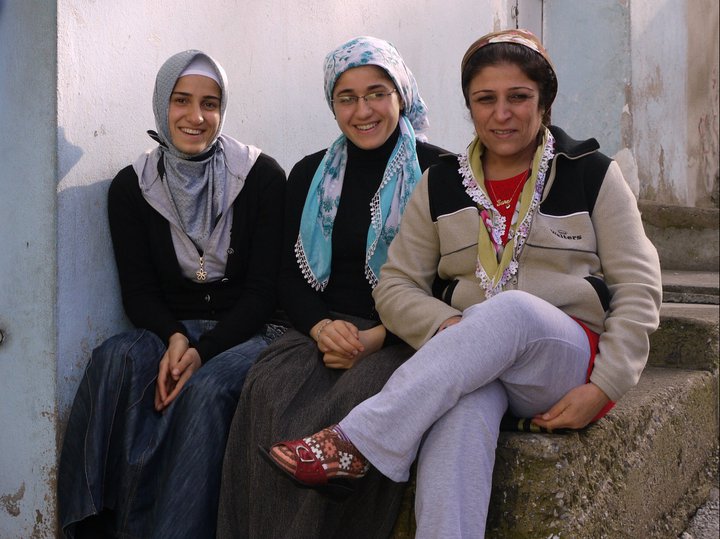
Walking around, I met a young girl. She told me that most of the people living here were Kurds, that the government had torn down their houses, and that everything was very bad. She was a very bright person and eager to communicate, but unfortunately I missed many of the things she told me, as I basically don't speak Turkish. But we walked around for a long time, and she introduced me to her neighbours and friends:


Intrigued about what had happened in their district, I started to make some research when back home, but initially didn't find much. Until I was looking again a couple of days ago, when I found a very well written and interesting report by two economists from Izmir University of Economics and Middle East Technical University, Neslihan Demirtas-Milz and Cenk Saracoglu:

The Urban Renewal in Kadifekale, Izmir: The Crossroads of Neo-Liberal Restructuring of Urban Space and Migration Through Internal Displacement (2011). 

Demirtas-Milz and Saracoglu place the problem into the wider context of the transformation of gecekondu (i.e.squatter) districts in big Turkish cities. Often located near the city center, these neighbourhoods of low-income housing are inhabited mainly by Kurdish migrants from eastern Turkey. As land near the city centers is valuable, migrants are increasingly evicted from their houses and settled in social housing projects along the city outskirts (Saracoglu has also written a book about the subject).

Kadifekale is a special case though, as the site is allegedly placed in a hazardous landslide area, and is supposed to be transformed into a park. At least in theory, evicted inhabitants should get compensation, and are eligible to buy appartments in subsidised social housing projects. However, many of them do not have formal ownership titles, and thus have no right to get compensated. And then the social housing is generally far from the city center. As most migrants work on local markets, they would lose their jobs if having to leave the area, in addition to losing the social ties and connections that existed in their old neighbourhood.

Wednesday, 7 March 2012

Beirut

Driving south from Tripoli along the Lebanese coast in the evening, you get a beautiful view of the sunset behind Beirut.


Beirut is one of the most interesting places I know. Although
the destruction caused by the civil war (1975-1990) was still
visible in December 2011, the city is incredibly dynamic, bustling with life.


Car horns are honking, building sites are everywhere,
and in the evening thousands of people enjoy walking
through the newly restored city center or along the seafront.


One evening, walking along the corniche, I saw a TV discussion being recorded on a rock in the sea, just below the promenade.


People were sitting in boats to watch the filming.


Beirut is incredibly diverse. In East-Beirut, the streets often look like those of a noble suburb in Paris, and loudspeakers from a Christmas-tree shop were blaring out petit papa noel.

Around the centre, one can still find the odd Ottoman or French-mandate building that has survived both the civil war and post civil-war reconstruction efforts.


Muslim West-Beirut is where business is done, with the streets around the American University busily bustling with people. In the southern suburbs, Hezbollah has a strong presence, with support for Syria visible everywhere.


Just a couple of minutes walk from this place, you come to the Palestinian refugee camp of Shatila. Since the massacre of 1982, the once low-rise refugee huts have been transformed into high assemblies of concrete blocks. The streets in between are so narrow and dark that even during the heat of the day, you feel a cold shiver. The picture below is a street along the border of the camp, not far away from the Ramallah Primary School operated by UNRWA.


When I passed by the gates of the school, I had to think about Omar Yussef, headmaster of an UN school for girls in Bethlehem and main protagonist of an excellent and  insightful series of crime novels about contemporary Palestine, written by Matt Rees.

Just afterwards, I met these guys. The one on the right was a baker, who invited us all to an excellent éclair au chocolat.


An omnipresent figure in Beirut is the late Rafiq Hariri. Although assassinated in 2005, his picture can still be found on every street corner.


Hariri made a lot of money in the 1970s, owning a construction firm used by the Saudis. Once he became Lebanese prime minister in the 1990s, he was the main figure behind Solidere, the company for the reconstruction of Beirut's city centre. A good book on Hariri is Killing Mr Lebanon, by Nicholas Blanford.

Ironically, the place where Hariri was assassinated in 2005 (by a road bomb near
the Hotel St. Georges) is now adorned by a huge poster attacking Solidere.
The company is criticized for paying no attention to Beirut's historical
heritage when restoring the city centre (chapter 7 of this excellent
book on the loss of cultural memory gives a detailed account).


After a week in Lebanon, I was deeply impressed by this vibrant, diverse and complex country.

When the plane took off back to Istanbul and the city disappeared below, somebody's cellphone rang. It was playing the famous song by Lebanese singer Fairouz, Li Beirut.